Nobody’s Listening to You Listen: The Case for Radio That Can’t Hear You Back
Photo: Harman Kardon/Microsoft, redistributed by MSPoweruser, Public domain, via Wikimedia Commons
Every speaker in my house is smarter than the radio in my kitchen, and only one of them asks me questions.
I got to thinking about this on a drive last month, somewhere between the interstate and the grocery store, with a station playing an ad for a mattress chain I have never once shopped at. It was, by every measure that the advertising industry cares about, a failure. Wrong person, wrong town, wrong mattress.
It was also the most relaxing ninety seconds of my week.
Two Kinds of Audio in Your House
Look at what audio has become in 2026. The speaker on the counter knows when I walk into the room. The streaming app knows what I skipped at 11:40 p.m. and has quietly built a genre out of it. The earbuds know my heart rate. Every one of these things is engaged in a long, friendly conversation with me about my habits, and every one of them is taking notes.
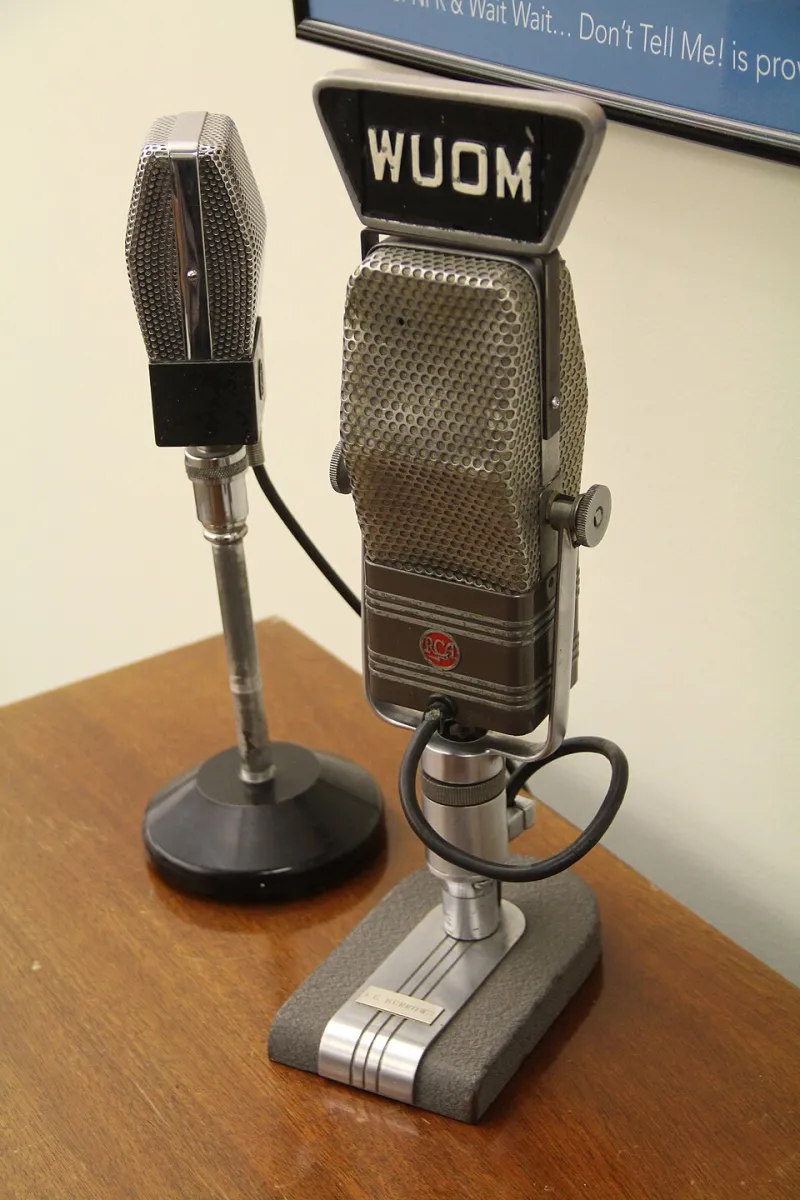
Then there is the radio, which knows nothing. It broadcasts into the air. Anyone with an antenna can catch it. Nobody knows who is out there. Nobody will.
That is not because radio is a stranger to measurement. It is because the measurement happens at the group level — ratings panels, meters carried by a sample of households, surveys — and never at the level of me specifically, sitting in my car, hearing a mattress ad that my neighbor also heard at the same time in her own car. The advertiser buys an audience, not a person.
The Relief of Being an Audience Instead of a User
Here is what I have come to believe: that inefficiency is the most underrated feature of the medium.
When a thing is free and untargeted, nobody has to justify it to you. The station does not need to keep you engaged, because engagement is not the product. It does not need your location, your contacts, or your microphone permission. It needs you to keep the dial where it is, and it earns that by playing something you like and getting out of the way.
Compare that with the modern audio experience, which is a relationship. It wants feedback. It wants to learn. Skip a song and you have taught it something. Say a word near it and you have taught it something else. The system improves constantly, and the improvement is the price.
Radio cannot improve on you, because it cannot see you. It can only improve on itself.
The Measurement Caveat, Because Someone Will Raise It
Is broadcast radio fully anonymous? Not perfectly. Ratings systems use panels of real households, and those households are tracked in aggregate. Public file requirements, FCC licenses, and station ownership consolidation all mean there is plenty to criticize about the business.
The point is not that radio is a privacy utopia. It is that the fundamental architecture is one-way. There is no opt-in, because there was never an opt-out. The signal goes out; whoever catches it, catches it. That is a structural fact, not a policy promise, and structural facts survive policy changes.
What One-Way Actually Buys You
A few things, and they are not small.
It buys you the freedom to be a bad listener. You can tune in halfway through a song, leave the room, come back, and never be asked to explain yourself. No history, no recommendations, no gentle suggestion that you have been listening to a lot of sad stuff lately.
It buys the small luxury of hearing something that was not selected for you. A station is a set of decisions made by people with a budget and a taste, and some of those decisions will miss. A miss is a gift. It is the only way to find out what else is out there.
And it buys a shared space that cannot be mined. Everyone at the diner at 7:40 a.m. is hearing the same thing. Nobody there is being sold a different version of it.
Keep Your Hands Off the Dial
I use the smart speaker. I use the apps. I am not writing this from a cabin in the woods, and I am not going to pretend the trade is always a bad one. Personalization is real, and sometimes it is genuinely good.
But I want the alternative to keep existing. I want one place in the audio landscape where the door only swings one way, where the people talking to me are not also compiling a file on me, where the transaction is: I give you my attention for twenty minutes, you give me music, weather, and a little company, and we both walk away.
That is not a limitation of radio. In 2026, it is the best thing about it.
Your Sound. Your Station. Always On.