Three Minutes at 4:55: The Only Room You Share With 400,000 Strangers
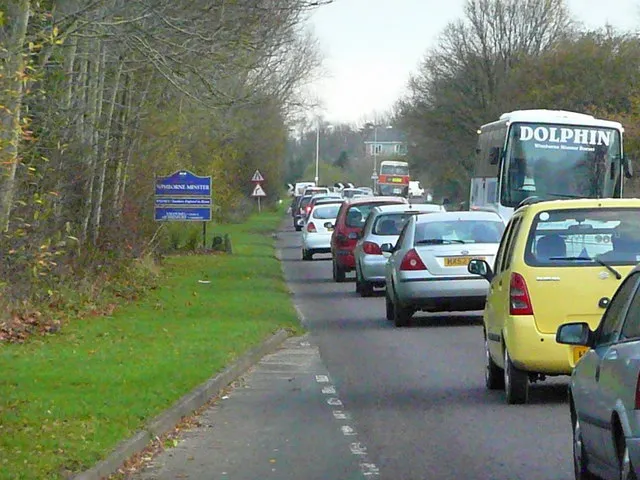
Photo: Jonathan Billinger, CC BY-SA 2.0, via Wikimedia Commons
You are idling in the left-turn lane at 4:53 on a Tuesday, and somewhere in the dashboard a voice you have never met is about to tell you something you already half-know.
There is a crash blocking the right lane two exits up. There is weather moving in from the west, maybe. And whoever is reading the drive-time update is about to say the words “alternate route” like it is a real option and not a fantasy.
Your phone already knows. It recalculated before you finished backing out of the parking lot. It knows the crash, the weather, and the precise shade of red your commute has turned.
You turn the radio up anyway.
The Church of the Same Three Minutes
Almost every commercial station in America has one. It airs at :15 and :45, or on the eights, or right after the top-of-hour news. It has a name — Traffic and Weather Together, Drive Time Double-Check, whatever the program director landed on in a meeting fifteen years ago — and a jingle that sounds like a seatbelt clicking.
And here is the strange part: it works. Not because it is accurate, though it usually is. Not because it is fast, though it is three minutes flat, every time. It works because it is the one appointment on the American dial that everybody keeps at once.
The morning version gets the attention. But the afternoon version is the one that feels like a campfire. Morning drivers are pointed in different directions — school drop-off, the early shift, the gym before work. Afternoon drivers are all doing the same thing at the same time: getting home. The 4:55 report catches a whole metro area in the same posture, hands at ten and two, all headed the same way, all hearing the same sentence about the same bridge.
Try to get 400,000 people to agree on anything else in a single afternoon. Go ahead. We will wait.
Why the Least Personalized Thing on Your Drive Hits Hardest
Everything else in your car has been tailored to you. The seat remembers your lumbar setting. The playlist knows you are going through something. The map app has quietly learned that you will ignore its suggested route and take the back way past the cemetery anyway, because you always do.
Advertising on streaming platforms has followed you in. Two people in the same house can listen to the same song and hear completely different commercials. That is sold as a feature, and for advertisers it is one.
Then the radio does something almost rude by comparison: it talks to everyone. Not to your demographic, not to your segment, not to the version of you that clicked on a mattress ad in March. To the whole metro. Same bridge, same bottleneck, same chance of rain.
That is the least efficient possible delivery system for information you can pull up in four seconds. It is also the only one that produces a shared experience out of the deal.
The Chopper, the Bridge, and the Guy Who Says ‘Alternate Route’
Part of the appeal is pure craft. Drive-time traffic is a live performance with a hard out. Somebody has to read scanner traffic, DOT feeds, and a producer talking in their ear, then compress all of it into sentences a person can act on at sixty-five miles an hour.
Good traffic reporters have a voice like a hand on your shoulder. They tell you what to do, not just what happened. They know that a stalled box truck on the shoulder is nothing, and that a lane closure near the interchange will add twenty-two minutes to your life. They know the difference between a delay and a disaster, and they do not waste your time on the first one.
And when something genuinely bad happens — a tanker, an ice storm, a bridge that suddenly is not a bridge — the radio is still the thing people reach for. The phone tells you the road is closed. The radio tells you why, how long, and which school district just called it.
What a Water Main Break Has in Common With a Campfire
Local identity is mostly made of small, unglamorous shared facts. Which exit smells like a refinery. Which overpass floods if you look at it wrong. Which school district cancels at the first flake.
A water main break on a Tuesday afternoon is not history. But in that moment, it is a thing that happened to everyone, and the drive-time report is where everyone finds out at once. Later that night, at the ballfield and the grocery store and the group chat, that shared three minutes is the reason nobody has to explain the traffic.
Social media was supposed to do this. It split into a million feeds instead. Personalized everything gave us more of what we like and less of what we have in common.
The Part Nobody Puts in the App
The map app will always beat the radio on precision. It will never beat it on company.
So next time the clock rolls to :55 and the seatbelt jingle comes on, do not skip it. Do not reach for the phone to double-check what the voice just told you. Just listen. Somewhere out there, a few hundred thousand people are listening to the same sentence about the same bridge, and for three minutes, all of you are in the same room.
Your Sound. Your Station. Always On.