You Spent Three Hours Building That Playlist and Haven't Played It Once
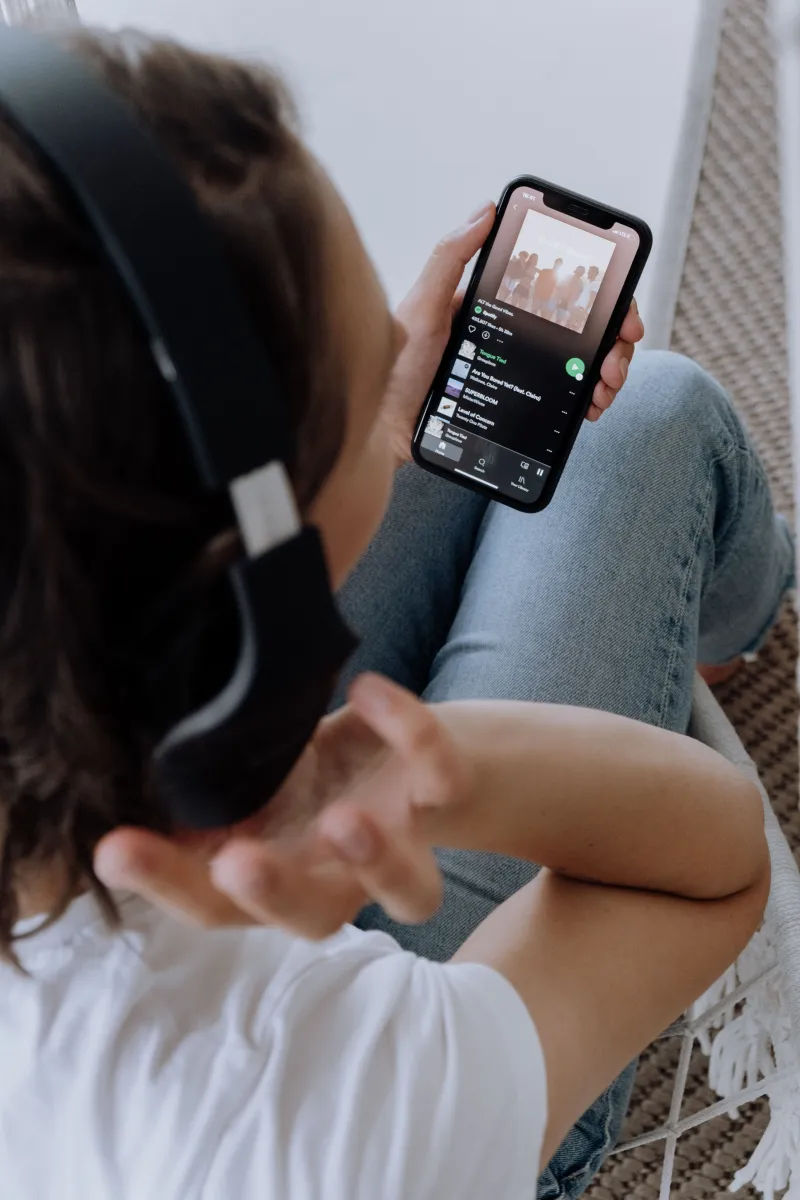
Photo: person overwhelmed looking at music streaming app on phone while headphones sit unused, via images.pexels.com
Be honest. You've got a playlist called something like "Sunday Chill Vibes" or "Late Night Drive" sitting in your library right now. You spent a solid chunk of your evening curating it — dragging songs in, rearranging the order, trimming the ones that felt slightly off — and then you hit save, closed the app, and never went back.
Don't worry. You're not broken. You're just human.
This is what behavioral researchers have started calling the playlist paradox: the strange loop where the more effort we pour into building a perfect listening experience, the less likely we are to actually use it. And while streaming platforms have handed us more musical control than any generation in history, a growing number of listeners are quietly abandoning their libraries and tuning back into live radio — where someone else just tells them what's next.
The Tyranny of Too Many Options
Back in 2000, psychologists Sheena Iyengar and Mark Lepper ran a now-famous study at a California grocery store. They set up jam tasting tables — one with 6 varieties, another with 24. The bigger display drew more curious shoppers, but the smaller one sold ten times more jam. When people had fewer choices, they actually made a decision.
Streaming music is basically that 24-flavor jam table, except it never closes and there are 100 million flavors.
Dr. Barry Schwartz, the psychologist who wrote The Paradox of Choice, has argued for years that unlimited options don't liberate us — they exhaust us. "The secret to happiness," he's said, "is low expectations." That sounds bleak until you realize what he actually means: when the decision is already made for you, you're free to just enjoy the thing.
This is exactly where radio has always had a quiet advantage, even when nobody was paying attention to it.
The Hidden Cost of the Curation Ritual
There's something seductive about building a playlist. It feels productive. It feels like self-expression. You're essentially composing a tiny autobiography in song form — here's who I am at 11 p.m. on a Tuesday in October.
But that ritual comes with a psychological price tag. Music streaming experts have noted that the act of curation creates what's sometimes called anticipated regret — the nagging sense that whatever you pick might be the wrong choice, that a better song is always one more scroll away. So you keep building. You keep refining. And the playlist becomes a monument to a listening session that never actually happened.
There's also something called listener's block, a cousin to writer's block, where the pressure of choosing the right music for your current mood becomes so heavy that you end up choosing nothing at all. You've probably experienced this — staring at your library on a Friday night, scrolling through albums you love, and somehow ending up watching YouTube instead.
Streaming platforms have tried to solve this with algorithmic playlists and auto-generated mixes. And sure, those help. But they come with their own friction: the music often feels impersonal, the transitions can be jarring, and there's a lingering awareness that what you're hearing was assembled by a machine optimizing for engagement metrics, not for you.
Why Radio Bypasses the Whole Problem
Here's what live radio does that your playlist library fundamentally cannot: it makes the decision irreversible. The song is already playing. You didn't pick it. It just showed up.
And weirdly, that's a relief.
When something is already in motion, our brains shift from decision mode into experience mode. We stop evaluating and start listening. The cognitive overhead disappears. You're not wondering if you should've queued up a different album — you're just in it.
This is a huge part of why Radio JXL listeners keep coming back even when they have access to every song ever recorded. The station makes the call. A real human being — someone who actually loves music and understands how a set should flow — has already done the heavy lifting. By the time you tune in, the only job you have left is to enjoy the ride.
There's also an element of social presence that playlists can't replicate. When a DJ breaks in between tracks, references something happening in the world right now, or just sounds genuinely excited about the next song, you feel like you're sharing the moment with someone. Music becomes communal again, even if you're sitting alone in your apartment with your headphones on.
The Paradox Gets Personal
Here's the part that really stings: the playlists you never listen to are often the ones you worked hardest on. The casual, thrown-together queues — the ones you built in five minutes because you just needed something to play while you cooked dinner — those get played on repeat. Because there was no pressure attached to them. No expectation of perfection.
This mirrors something researchers have found about creative work in general: the more emotionally invested we are in a project, the harder it becomes to engage with it casually. Your meticulously built "Best of 2024" playlist isn't just music anymore — it's a statement, an artifact, something that can theoretically be judged. So you protect it by never pressing play.
Radio doesn't have that problem. Nobody's judging you for listening. Nothing is riding on it. It's just sound, and it's already happening.
What This Means for How You Actually Listen
None of this is an argument against playlists. They're great. Keep making them. But if you've noticed that your most satisfying listening sessions lately happen when you're not the one in control — when you've got a station running in the background and you're just living your life inside of it — that's not a coincidence.
The music that moves us most is often the music that arrives unexpectedly. The song you didn't plan for. The one that comes on mid-commute or mid-workout or mid-whatever and just lands. Radio has been engineering those moments for decades. It's the whole point.
At Radio JXL, the programming isn't random and it's not robotic. It's shaped by people who think about transitions, energy, timing, and the invisible thread that connects one song to the next. That's not something an algorithm has figured out yet — and honestly, it might not need to, because the humans doing it are still doing it better.
So go ahead and build the playlist. Spend the hour getting the order just right. Save it with a name that feels meaningful.
And then maybe, just maybe, flip on the station instead — and let somebody else take the wheel for a while. Your library will still be there when you're ready. But right now, something good is already playing.